Steam Heat & Radiator Repair in New Springville, Staten Island
Persistent cold rooms, violent pipe knocking, and leaking air vents disrupt comfort across Richmond County homes every winter. When you need dedicated radiator repair New Springville Staten Island property owners trust, we diagnose whether thermal imbalance stems from clogged valves, unpitched pipes, or core boiler pressure faults.
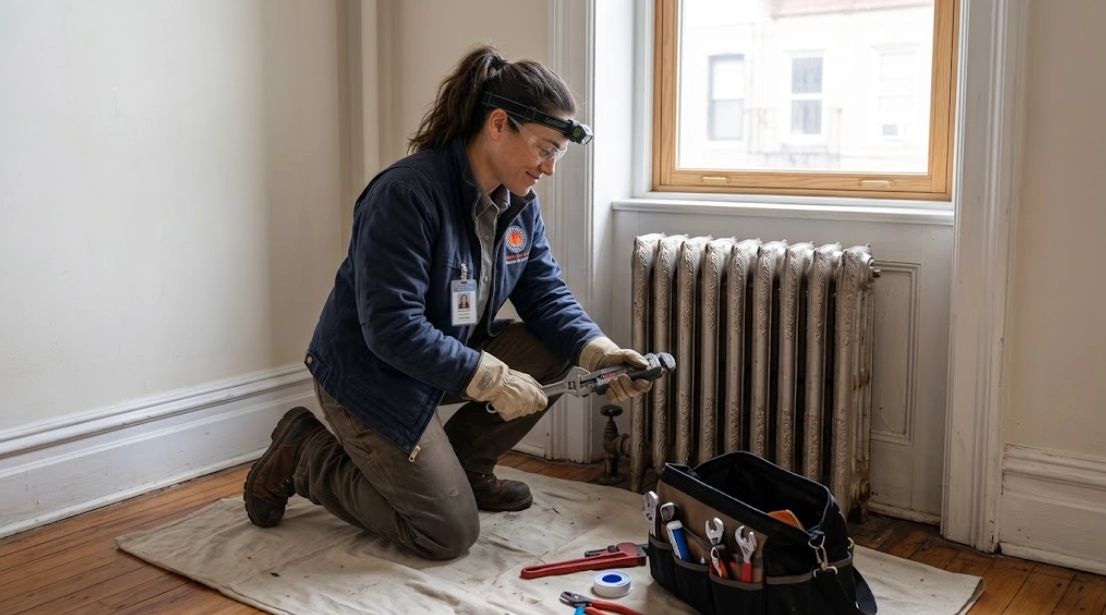
Why Steam Radiators Bang, Leak, or Stay Cold
Understanding single-pipe steam and hot water radiator dynamics in Staten Island homes.
Violent Banging & Water Hammer
Metallic clanking happens when incoming steam collides with condensate trapped in the radiator body or supply run. If the radiator has settled backwards over decades, condensate cannot flow by gravity through the supply pipe back down to the boiler.
Completely Cold Radiator Units
When a radiator refuses to heat up, the internal air is usually trapped. If the automatic air vent is jammed shut with mineral deposits or rust scale, fresh steam is physically blocked from filling the cast-iron ribs, leaving the entire room freezing.
Hissing Vents & Water Spitting
Air vents that constantly spit boiling water damage hardwood floors, peel plaster, and warp baseboards. This points to worn float mechanisms inside the vent spud, excessive boiler waterline levels, or dangerous system-wide overpressurization.
Is It a Radiator Defect or a Central Boiler Failure?
Many homeowners near the Staten Island Mall or along Richmond Avenue assume a cold room requires immediate radiator replacement. However, localized heating failures often originate deep in the basement equipment rather than the cast-iron terminal unit itself:
- Boiler Vaporstat & Pressure Settings: Residential steam boilers should operate at ultra-low pressures (0.5 to 1.5 PSI). Excessive pressure forces condensate against supply pipes, halting steam delivery to distant second-story radiators.
- Main Line Basement Quick Vents: If the primary steam mains in your basement lack functional quick vents, steam moves too slowly, leaving peripheral rooms cold while central zones overheat.
- Supply Valve Gate Jamming: Decades-old bronze valves can detach internally from their stems. Even if the handle turns freely, the interior gate may remain stubbornly shut.
- Piping Pitch & Shimming: Settling foundations tilt radiators toward their blind ends. Restoring a subtle 1/4-inch slope toward the inlet valve ensures swift condensate drainage.
When heating problems involve systemic firing cycles or boiler control shutoffs, review our comprehensive boiler repair in New Springville protocols or explore whole-system upgrades via boiler replacement.
The One-Pipe Steam Valve Rule
A critical rule for Richmond County homeowners: on single-pipe steam systems, never partially throttle the supply valve to modulate room warmth.
Unlike hydronic radiators, steam and liquid condensate share the exact same pipe. Half-closed valves throttle the return channel, creating immediate water hammer, vent spitting, and floor damage. To regulate individual room temperatures properly, we install precision thermostatic radiator valves (TRVs) paired with calibrated venting orifices.
Frequently Asked Questions About Radiator Repair
Direct, practical answers regarding cast-iron steam and hot-water radiator systems.
Why is my steam radiator banging and hammering violently?
Pipe hammering (water hammer) occurs when condensed steam cannot drain freely back toward the boiler. Steam traveling at high velocity collides with trapped pooling water, creating shockwaves. Common causes include a closed or partially shut inlet valve, an unpitched radiator sagging backward, or a clogged steam trap.
Can I replace a hissing steam radiator air vent myself?
While air vents screw into the radiator spud, attempting replacement on an active, pressurized, or corroded system can strip delicate threads or cause scalding steam burns. An inspection ensures the correct venting rate is matched to your room's thermal load and system pressure.
Why is my radiator completely cold while others in the house are scorching hot?
A cold radiator in an otherwise active steam heating circuit is usually air-bound. If the air vent fails to vent atmospheric air, incoming steam cannot enter the cast-iron sections. Other potential faults include a frozen supply valve stem or incorrect main venting in the basement.
Should radiator supply valves be kept partially closed to lower room temperature?
On standard one-pipe steam systems, radiator supply valves must be either 100% fully open or 100% fully closed. Throttling the valve halfway restricts the narrow return path of liquid condensate against oncoming steam, causing immediate water hammer, spitting vents, and floor leaks.
Related Services & Local Heating Support
Explore connected mechanical services for residential properties throughout Richmond County.
Central Boiler Repair
From low-water cutoff diagnostics to burner ignition faults, restore reliable steam and hot-water output at the source.
Explore Boiler Repair →High-Efficiency Replacement
Upgrade worn, inefficient boilers with cast-iron or modern condensing units sized to match your radiation capacity.
View Replacement Options →Regional Service Coverage
We serve homeowners across New Springville, Bloomfield, Travis, Bulls Head, Westerleigh, and nearby neighborhoods.
Review Service Areas →Have an urgent heating question or preparing your radiators for winter? Contact our local dispatch team directly.
Visit Contact Page